

Brooklands Museum

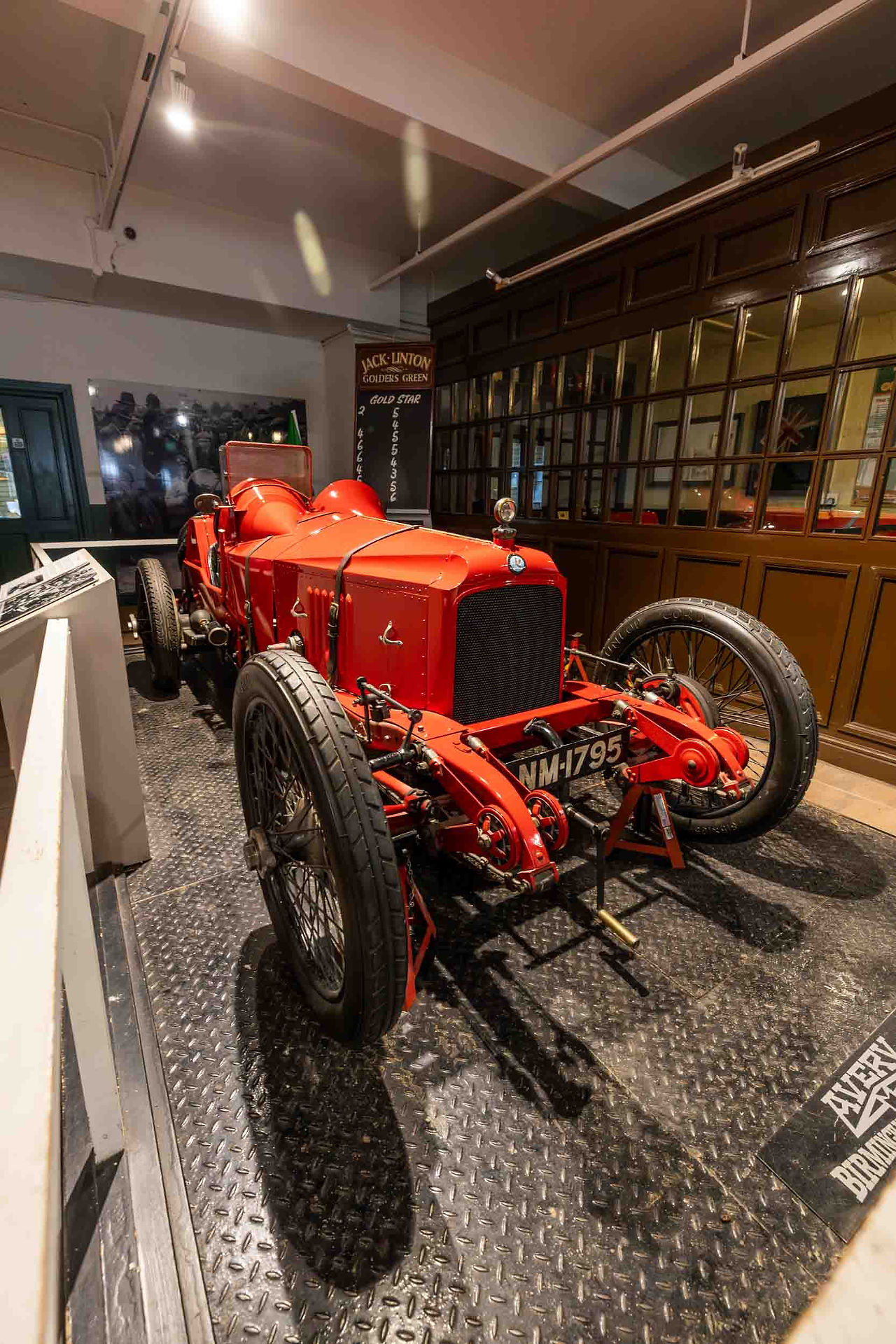
Brooklands actually started out life as a motoring circuit, the creation of Hugh Fortescue Locke King, it was to be the first ever purpose built banked circuit. In 1903 an Act was passed by parliament called the 'Motor Car Act' which would enforce a 20 mph speed limit across all public roads. At this time in history nearly 50% of all cars were made in France and there was a growing concern that Britain would fall behind in it's industry standards. This is when King Edward VII stepped in and commissioned Colonel Capel Lofft Holden of the Royal Artillery to begin work on designing a suitable circuit.
Work began in 1906, the track would be 30 meters wide and 2.767 miles in length and an embankment of 9.1 meters in height. In addition a 'Finishing Straight' was added extending the circuit to 3.369 miles which included the embankment which measured 1.250 miles on it's own. Brooklands was designed to hold a capacity of 287,000 spectators in it's heyday and would have been an incredible sea of colour, machines and vigor for the exciting new craze that was motoring. The track was officially opened on 17th June 1907, where Lord Montagu of Beaulieu, Hugh Owen, Julian Walter Orde and Colonel Holden were credited as being the main facilitators for the track being built on Mr Locke King's land. The opening day featured a procession of 43 cars around the circuit, one of which was driven by the famous Charles Rolls. The first official event was held on 28th-29th June 1907 where 3 cars would compete in a 24 hour race for the world record for distance covered in that time frame.

Anyway let's move on from motor racing and look into the aviation side of Brooklands. Brooklands was one of Britain's first ever airfields. In 1908 Alliott Verdon-Roe, more commonly known now by manufacturing as AVRO, conducted the first ever taxiing and towed flight trials of a British full sized powered aircraft by a British aviator. However on Friday 29th October 1909 Frenchman Louis Paulhan in his Farman biplane became the first official flight from Brooklands. He would go onto set a new British endurance record of 2 hours 49 minutes and 20 seconds.

During 1910 Brooklands became a major centre of flying in Britain with Hilda Hewlett and Gustave Blondeau opening Britain's first flying school which incidentally they went on to create the Hewlett & Blondeau Limited company in aircraft manufacturing. Late in 1910 the Bristol Aeroplane Company also established a flying school at Brooklands with it's first instructor being Archie Low who coined the phrase 'Drag' referring to aerodynamic drag. A. V. Roe also started a flying school on the site as well as Vickers in January 1912 where the future Air Chief Marshal Sir Hugh Dowding would learn to fly. In February 1912 Thomas Sopwith established his flying school and in June 1912 along with several other pioneers they set up the Sopwith Aviation Company (although important to note that the manufacturing was conducted at Kingston upon Thames).

On the outbreak of war in July 1914 Brooklands closed as a racing circuit and was requisitioned by the War Office and subsequently Vickers Aviation Ltd set up a factory on the airfield in 1915 making Brooklands a major centre of engineering and testing of military aircraft. Military flying training was conducted on the airfield here until the end of 1915 when the Royal Flying Corps moved in forming 1, 2, 8, 9, 10 and 23 Squadrons on this site. From 1912 Marconi has been conducting pioneering wireless trials and developments at Brooklands and it was at Brooklands that they worked with several RFC units testing the technology for airborne usage. It was here that in 1915 the world's first ever voice to ground wireless message was transmitted, once again putting Brooklands into the history books.
After the First World War Brooklands Aviation Ltd was formed in 1931 with Percy Bradley, Duncan Davis, Fred Sigrist and Ted Jones as directors. They would be responsible for operating the aerodrome and would commission Graham Dawbarn to design the Brooklands Aero Club House in that famed Art Deco styling. That opened in May 1932 along with a Brooklands School of Flying which also led them onto having sites at Lympne, Shoreham and Sywell. In the early 1930s Brooklands Aviation won a War Department contract for pilot training catering to the Royal Air Force where N°6 Elementary Flying Training School was established at Sywell on 10th June 1935.

During WW2 Brooklands Aviation became a contractor to the Civilian Repair Organisation which would repair the likes of the Vickers Wellingtons and Warwicks. It was at Brooklands the on the 6th November 1935 the Hawker Hurricane took it's first flight at the hands of Flight Lieutenant P.W.S. 'George' Bulman. Brooklands housed very important production and developments efforts during WW2, which meant substantial efforts where made to conceal it, despite this the site received extensive damage by the Luftwaffe on 4th September 1940 when nearly 90 aircraft workers were killed and 419 injured with 5 unidentified victims being buried in unmarked graves in Burvale Cemetery in Hersham. Two days later on 6th September 1940 the Hawker Factory was also bombed but this time with no loss of life or disruption to production. Random story time, on 21st September 1940 Royal Canadian Engineer Lieutenant John MacMilan Stevenson Patton along with 5 others successfully rolled an unexploded bomb away from the factory into a nearby bomb crater which exploded without any harm or damage. This act of bravery won him the George Cross.

After the bombings in September 1940 it was decided that the Vickers-Armstrong design department, which consisted of some of the foremost minds in Britain such as Rex Pierson, Barnes Wallis and George Edwards, should be dispersed to two separate facilities. Burhill Golf Course and Foxwarren in Redhill Road Cobham. These two facilities played a crucial part in the development of 'Upkeep' better known today as 'The Bouncing Bomb' famously used by 617 Squadron on Operation Chastise.
RAF Flying training ceased at Brooklands in 1946 and the circuit of Brooklands was in very poor condition and subsequently sold to Vickers-Armstrong in 1946. The site continued to be used by the company for design and development producing the likes of the Viking, Valetta, Varsity, Viscount, Vanguard, 1-11 and VC10. In 1951 a brand new hard runway was constructed meaning that part of the old circuit at Byfleet had to be removed to allow the Vickers Valiant to be flown out to nearby Wisley airfield. Brooklands was used for testing and manufacture until 1972 where it latterly became part of BAC. In the 1960s BAC was headquartered at Brooklands, their facilities had grown exponentially and featured some of the best hangers in Europe. BAC went onto design and develop the TSR.2 and the Concorde from Brooklands which I think you can agree are aviation royalty.

Brooklands met its end as a production facility on Christmas day 1989 under the guise of British Aerospace or BAE. Apparently BAE Systems as it is now known retain a logistics centre on the site. In November 2009 Brooklands made it back into the public's consciousness with James May's Toy Stories where he undertook to create a Scalextric track on sections of the original embankment.
Onto what we have today, the Brooklands Museum Trust was formed in 1987 by Sir Peter G Masefield with the express aim to record, research, preserve and interpret the sites heritage and legacy. The site has now been featured on 'The disappearance of Mr. Davenheim' (a Poirot), The Bill and most famously Downton Abbey. Thankfully in 2002 the original Clubhouse (1907), Flight Ticket Office (1911) and Booklands Aero Clubhouse (1932) all were awarded protection under the 1975 preservation order.
Booklands Museum houses an impressive array of important aircraft in its collections, the list below is only the major pieces they have on display. If you go there I can guarantee you will find smaller but significant pieces of British aviation history in their collection. But I won't spoil the surprises, this is the kind of thing you can to discover for yourself.
Aircraft | Airframe | Notes |
Avro 504 K | Replica - Built as a prop for the film 'Aces High' | |
Concorde | G-BBDG | |
BAC One-Eleven | G-ASYD | Test aircraft and the first to carry fibre optic cables |
BAC TSR-2 | Cockpit section only - used for ejector seat testing | |
Bleriot XI | Replica | |
Hawker Siddeley Harrier GR.1 | XV741 | This aircraft won the Daily Mail Transatlantic Air Race in 1969 |
Hawker Siddeley P.1127 | XP984 | The last P.1127 every built and used extensively for testing, even being flown by Hugh Merewether |
Hawker Siddeley Harrier T.MK.52 | G-VTOL | This was the first ever 2-seat trainer and the only one of its type in exsistance |
Hawker Siddeley Hawk Mk.50 | G-HAWK / ZA101 | 1 of 8 built by Hawker Siddeley (BAE Systems) as a demonstrator / Test aircraft |
Hawker P.1121 | Prototype airframe and believed to be the only survivor | |
Hawker Fury Mk.1 | Replica | |
Hawker Hurricane | Z2389 | Assembled at Brooklands in 1941 it served with the RAF and then in Russia where it was shot down. |
Hawker Hunter F.Mk.51 | E-421 | Served with the Royal Danish Air Force from 1956 to 1973 and later an instructional air frame at Kingston |
Hawker Hunter GA.11 | XF368 | Disassembled state - a survivor from Thunder City |
Royal Aircraft Factory SE5a | Replica | |
Santos-Dumont Demoiselle | Replica | |
Sopwith Camel F.1 | Replica | |
Sopwith Schneider (Tabloid) | Replica | |
Supermarine Swift F.4 | WK198 | Originally an F.1 variant it briefly held the Air Speed Record in 1953 reaching 735.7 mph |
Vickers VC-10 - 1101 | G-ARVM | The very last standard VC10 to be produced at Brooklands |
Vickers VC-10 - 1103 | G-ASIX | |
Vickers VC-10 | Cockpit section for testing | |
Vickers Vanguard 953C | G-APEP | Last airworthy Vanguard to fly and the last heavy aircraft to land at Brooklands |
Vickers Vanguard | Flight deck Mockup | |
Vickers 498 Viking 1A | G-AGRU | Constructed at Brooklands and is the only Viking of it's type left in the UK |
Vickers Viking Mk.IV | Replica - Built for the 1977 film 'The People That Time Forgot' | |
Vickers Valiant B(K).1 | XD816 | Cockpit section only and comes from the last ever Valiant to fly |
Vickers Varsity T.1 668 | WF372 | 8th Varsity to be built and delivered to the RAF |
Vickers Viscount 806 | G-APIM | One of the last Viscounts built at Brooklands |
Vickers Viscount 837 | XT575 | Cockpit section only - served with RAE |
Vickers Viscount 813 | G-AZLP | Cockpit section only |
Vickers FB27 Vimy | NX71MY | Replica - it flew 3 long distance routes to Australia, South Africa and Atlantic Crossing |
Vickers Wellington Mk.1a | N2980 | 1 of 2 survivors, it took part in the Battle of Heligoland Bight. It was recovered from Loch Ness in 1985 |
White Monoplane | Replica | |
White Sports | Replica |
And now for the reason we are here today, the BAC Concorde. Brooklands' Concorde, G-BBDG, affectionately known as 'Delta Golf'', was specifically built for evaluation testing. She first flew on 13th February 1974 five years after the first ever Concord flight in 1969. This particular aircraft did feature some variations from the final production design such as a thinner fuselage skin. Delta Golf's last flight was on 24th December 1981 having amassed only 1282 hours and 9 minutes on the airframe over the course of just seven years. In retirement she was stored at Filton in what was described at 'semi-airworthiness' state where, should it be required, she could return to the air within two weeks. In 1984 she became part of a British Airways buy out and inevitably used for spare parts for a fleet of just seven aircraft under BA.

In the late 1980s a hanger was constructed for her at Filton with the tail being removed prior to storage. During 1995 Concorde G-BOAF suffered a nose damage at Heathrow, as a result the nose of Delta Golf was swapped to repair the damaged Alfa Foxtrot. However the original nose did make its way back to Delta Golf years later at Brooklands. Delat Golf, whilst in storage at Filton, did forfeit its original engines, landing gear and the majority of the hydraulics system. Delta Golf was subject to the hangman's noose many times with the looming threat of the scrapheap but always somehow managed to dodge it being deemed as 'useful'.
In 2001, in the wake of the September 11th attacked, she was used to test reinforced cockpit doors ensuring a safer future for commercial aviation in Great Britain. The Concorde fleet retired in 2003 and Delta Golf found it's way to its now home at Brooklands. Being dismantled into five major sections, it was transported by road from Filton and now sits proud outside the museum as a monument to the extraordinary achievements made in those early days by BAC.
This year marks 50 years since Concorde was introduced into service on 21st January 1976. One cannot help but wonder what might have been should Concorde and its aeronautical excellence been allowed to stretch it's wings even further.

This evening's shoot was ran by Threshold Aero and facilitated by the Brooklands Museum themselves so a huge thanks goes out to everyone involved in making this possible!


Comments